

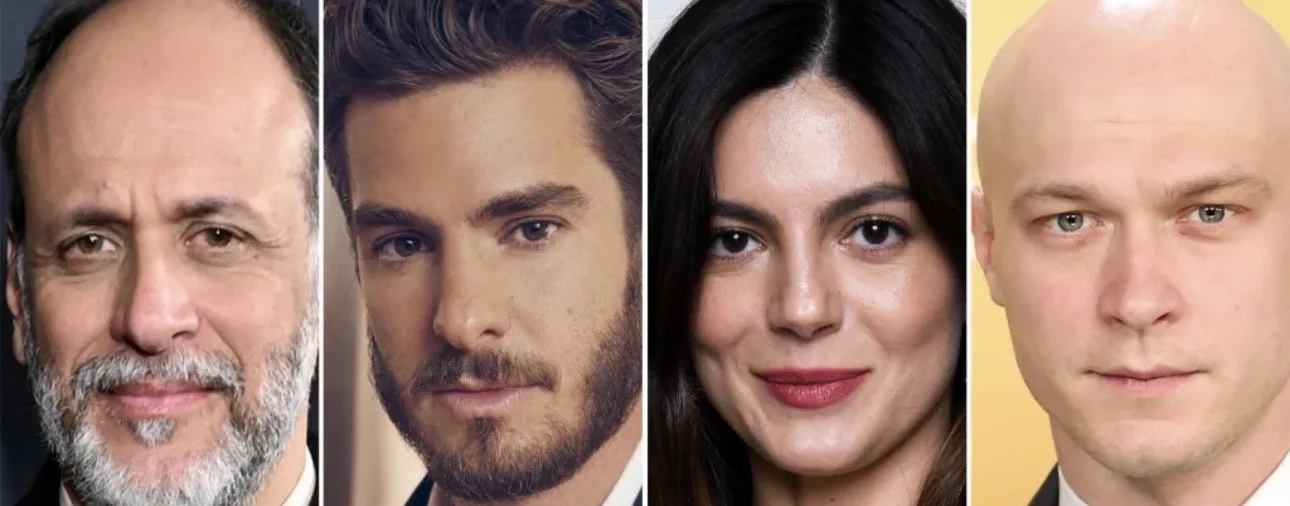
A recent private screening of “Artificial” suggests Luca Guadagnino might have made one of his most zeitgeisty films yet. It’s very much a “right place, right topic” kind of project—a portrait of the AI boom. I won’t get too deep into reactions since the film is still being edited (the cut shown was just under 2h30), but early word is mixed-to-positive, with much of the praise going to the performances and especially the score.
A common reaction describes “Artificial” as “The Social Network,” but for the AI era. It dives into the rise of OpenAI and the personalities behind what might end up being the most important tech shift of our time. Made on a reported $40M budget, it’s all about clashing egos, big ideas, and the dubious ethics that come with building something this powerful, this fast.
The movie mainly follows Ilya Sutskever (played by Yura Borisov), who essentially carries the first half. He’s portrayed as the idealistic, slightly naive brain of the operation—the one who truly believes in the bigger picture, much like Eduardo Saverin in “The Social Network.” However, as the film progresses, the spotlight gradually shifts to Sam Altman, played by Andrew Garfield, who, interestingly enough, previously portrayed Saverin in ‘Social Network.’
Garfield’s performance is one people seem split on. He starts off pretty grounded, but as the movie goes on, it sounds like he leans more into a heightened, almost exaggerated version of Altman. On the flip side, Jason Schwartzman and Cooper Hoffman are getting a lot of love—they seem to be the quiet MVPs of the ensemble. Hoffman is a co-developer in the film’s second act, while Schwartzman appears in a minor role as a disgruntled tech innovator who delivers a monologue to Borisov’s character about the far greater risks of allowing AI to spiral out of control.
Then there’s Elon Musk… played by Ike Barinholtz, and yeah, this is where things get a bit weird. The performance apparently goes pretty broad—almost sketch comedy-level at times. Musk shows up as an early OpenAI backer but is mostly distracted by his glitchy self-driving Tesla instead of, you know, the future of humanity. After trying (and failing) to merge OpenAI with Tesla, he pulls out and basically disappears from the movie.
Tone-wise, “Artificial” is kind of doing two things at once. It’s part love letter to Silicon Valley—especially San Francisco—focusing on the power players, and part warning about where all of this could be heading. But interestingly, AI itself isn’t really the entire focus. It’s more in the background, while the movie zeroes in on the people building it and all their quirks, ambitions, and contradictions.
Instead of working again with Justin Kuritzkes, Guadagnino brings in a newer writer with a comedy background (“Saturday Night Live,” “An American Pickle”). You can kind of feel that in the script—it’s satirical, super dialogue-heavy, very insider-y, and not always concerned with explaining the tech in accessible fashion.
One thing almost everyone seems to agree on: the score rules. Even without Trent Reznor and Atticus Ross this time (who, funnily enough, also did “The Social Network”), Guadagnino brought in Blur’s Damon Albarn, whose music still taps into that same pulsing, tech-thriller vibe.